Glass or plastic? This is why many choose glass for food storage

Updated on
Glass eller plast? Derfor velger mange glass til matoppbevaring

When it comes to food storage, there are many solutions to choose from. Plastic is lightweight, practical, and has many useful applications. At the same time, many choose glass for storing dry goods, leftovers, and homemade food.

Why choose glass for food storage?

Glass is durable, easy to clean, and can be used again and again. That makes it a good choice for the kitchen – whether you're organising dry goods, storing leftovers, or filling jars with something you've made yourself.
Airtight storage extends shelf life
Norgesglasset oppbevaringsglass med trelokk samlebilde miljø

Glass has a smooth, non-porous surface. It doesn't absorb odours or colours the way some other materials can over time.

That makes glass well suited to foods where taste and aroma matter, like coffee, tea, spices and homemade food. It's also easy to see what's inside a jar, and how much is left.

And a jar can be washed and reused for a new purpose, again and again.

Glass doesn't hold on to smells or flavours

Have you ever noticed a storage container that still smells of last night's dinner, even after washing? Some materials can absorb odours or become discoloured by the food stored in them over time.
No color or smell will stick to the glass

Glass has a smooth surface that doesn't absorb flavours or odours. Once it's clean, a jar is ready for something completely different.

The same Norgesglass jar might hold homemade jam during berry season, granola for breakfast later in the year and nuts or other dry goods when your needs change.

Clear jars make it easier to use what you have

One of the simplest benefits of storing food in glass is that you can see what you have.
Good overview means less food waste

Rice, pasta, flour, oats, nuts and other dry goods become visible in the cupboard. In the fridge, it's easier to spot leftovers and prepped ingredients.

Good visibility can make it easier to use what you already have, before buying more or forgetting it at the back of the shelf.

One jar, many uses

Glass is made to be reused. That means the same jar can take on many different roles over its lifetime.
One glass - many possibilities

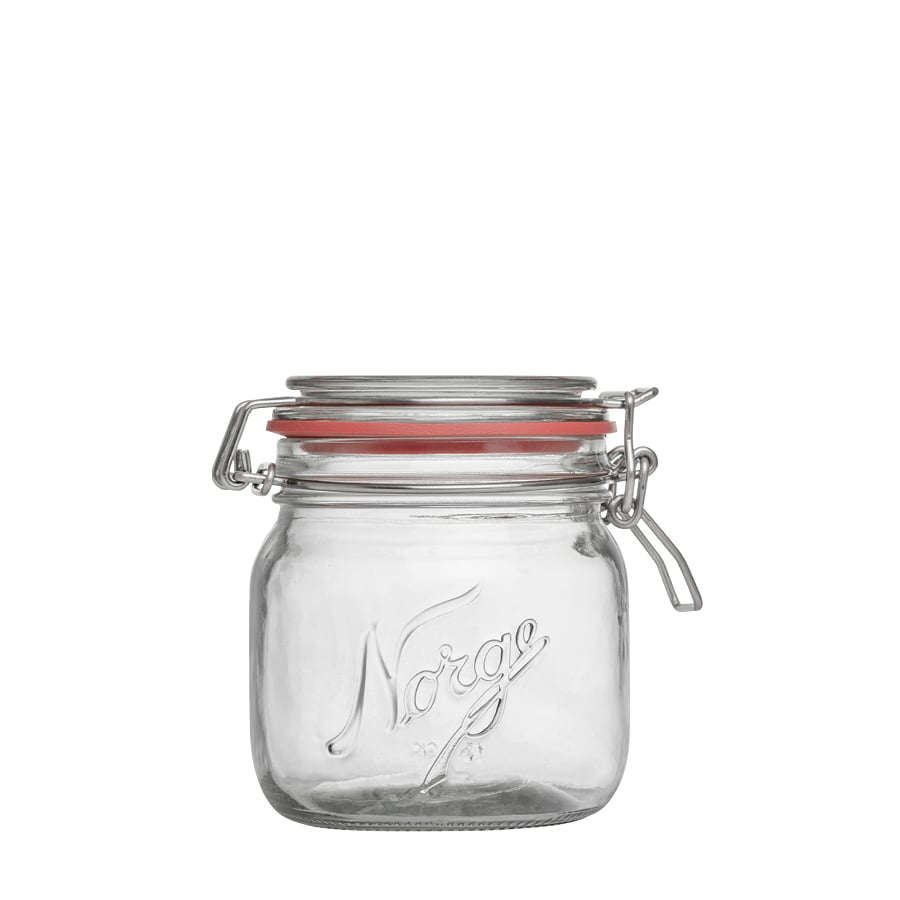
Norgesglass jars can be used for:

  • dry goods like flour, pasta, rice, oats and nuts
  • coffee, tea and spices
  • homemade jam and other food
  • leftovers and prepped ingredients
  • breakfast and food prep
  • dressing and other small dishes

Norgesflaske bottles can be used for water, juice, cordial and other cold drinks.

When your needs change, the jar can be washed and filled with something new.

Glass or plastic – which should you choose?

No single material is right for everything. Plastic has properties that make it useful in many situations. It's light and hard to break, which gives it uses where glass isn't necessarily the most practical choice. But when you want a container you can use again and again for food and drink at home, glass has several practical advantages. It's easy to clean, doesn't absorb flavours or odours and makes it easy to see what's inside. So you don't need to replace every plastic container in your kitchen. When something needs replacing, or you need new storage, glass can be a good alternative where it fits.
Glasses that can withstand the freezer and refrigerator, but also look good on the table

From preserving to today's kitchen

When Norgesglasset arrived in Norwegian homes in 1902, its usefulness came first and foremost from the need to preserve food. Fruit and berries could be preserved, ingredients kept and food stored for later. Much has changed in the kitchen since then, but the core idea still holds.

Today, we fill our jars with everything from coffee and oats to breakfast, leftovers, juice and homemade jam. The old principle remains the same: use good containers, look after your food and use them again.

Small choices that last

A more plastic-free everyday life doesn't have to start with replacing everything you own.

It can be as simple as refilling a bottle you already use, storing dry goods in glass or giving an empty Norgesglass jar a new purpose.

Small choices become habits – and good products can last a long time.